





















Tel: +30 210 92 30 422
E-mail: info@haee.gr
Address
62, Charilaou Trikoupi Str.
Kifissia, 14562
Athens, Greece
Join the leading platform for showcasing recent advancements and research outcomes in the field of energy. Whether you are an academic, researcher, manager, industry professional, or student, this is your chance to exchange your research discoveries with international experts.
Participants are encouraged to join the Symposium and submit their original, high-quality research, present their latest findings, engage in meaningful discussions, and contribute to shaping policies and strategies that will enable Greece and the broader EU to achieve their ambitious climate and energy goals.
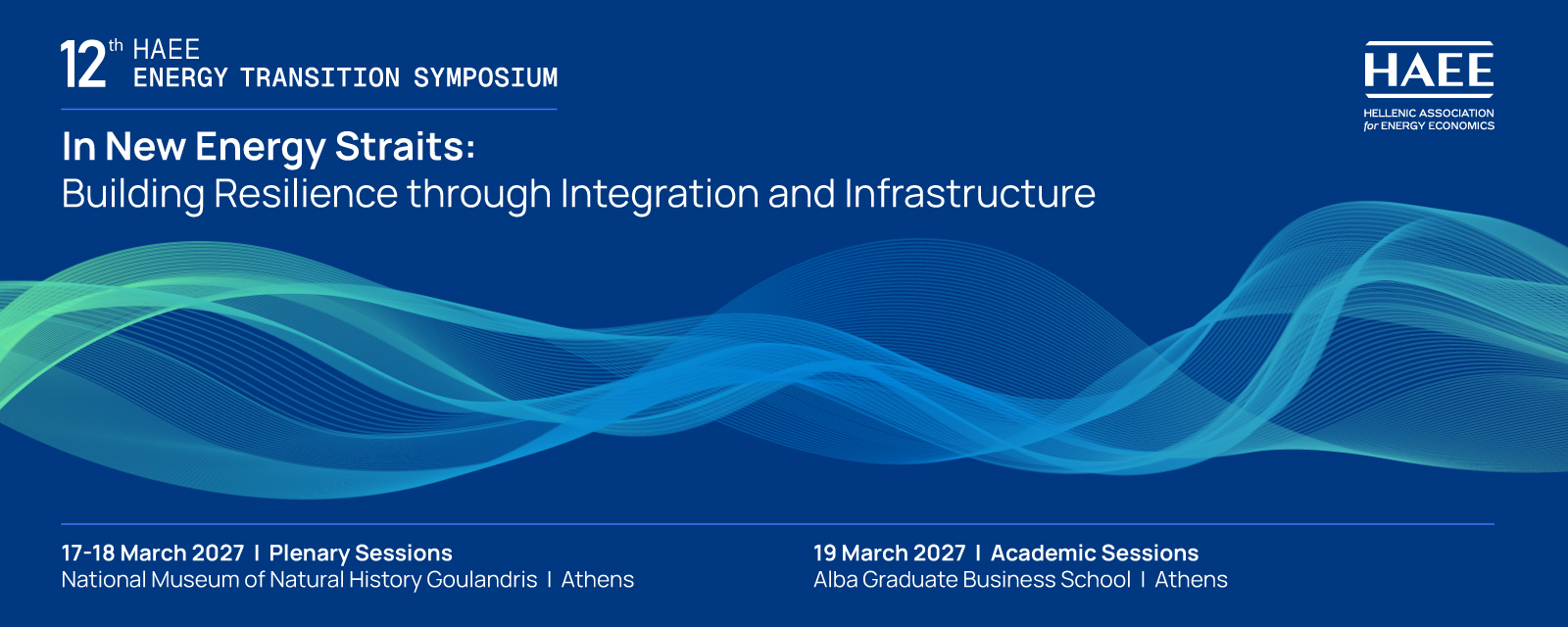
The 12th HAEE Energy Transition Symposium, titled " In New Energy Straits: Building Resilience through Integration and Infrastructure" will take place from 17 to 19 March 2027 in Athens, Greece.
To better serve our diverse program, the Symposium will be hosted at two distinct locations:
This year’s Symposium will delve into the complex geopolitical, economic, and policy dynamics currently shaping the global energy landscape. It serves as a premier meeting point for leading companies, policymakers, and key stakeholders to exchange insights, foster strategic partnerships, and contribute to the evolving energy agenda.
Call for Papers
In the framework of the Symposium, we are officially launching a Call for Papers and warmly invite researchers, academics, and emerging scholars to submit their latest work. This is a unique opportunity to present your research to a high-level audience of experts and industry leaders.
Students are especially encouraged to participate and may attend the Symposium at a reduced student registration rate.
The list of topics to be addressed includes, but is not limited to:
Scope: the security and physical-flow dimension of energy supply — geopolitical risk, chokepoints, routing, and infrastructure resilience under stress. The economic and asset-lifecycle questions surrounding gas’s transitional role are addressed in Topic 5.
Scope: the operational and technical layer of the grid — managing congestion, maintaining system stability, and applying digital and AI tools to integrate high shares of renewable generation, as distinct from the storage assets covered in Topic 3.
Scope: storage as a system asset — its technical role in balancing and reliability, the market and regulatory design that remunerates it, and the investment and risk considerations behind its deployment across battery and long-duration technologies.
Scope: decarbonizing hard-to-abate industry — carbon capture, transport, and storage, low-carbon molecules such as hydrogen, and the policy and financing instruments, from carbon contracts to CBAM, that make abatement bankable.
Scope: natural gas and hydrogen through an economic and asset-lifecycle lens — their transitional roles, valuation, stranded-asset risk, pipeline-repurposing and retrofit-versus-retire decisions, and just-transition economics, as distinct from the near-term security questions in Topic 1 and the industrial hydrogen applications in Topic 4.
Scope: the finance and policy architecture of the transition — disclosure and ESG frameworks, the macroeconomics of climate commitments, and the capital-market instruments that mobilize private investment into low-carbon assets.
Scope: the demand side of the transition and how to serve it reliably — the drivers of load growth and the dispatchable low-carbon resources and market designs that provide firm capacity alongside variable renewables.
Submission Procedure
Authors should firstly create an account, and then activate it, following the simple instructions provided below.
To upload their paper abstract, authors should press the button “Submit Paper” and provide some key features about their paper (title, key words, authors and paper presenter). Submitted abstracts should be no more than two pages in length, comprising of: i. overview, ii. Methodological approach, iii. results, iv. Discussion and conclusions, conforming to the structure outlined in the abstract template. All abstracts will be reviewed and evaluated by the Symposium’s Scientific Committee based on originality, accuracy, and relevance to the topics of the call. Authors will be notified by e-mail, should their abstract be accepted.
Please note that the Scientific Committee will consider only original research for publication. Articles that have been published elsewhere or are currently under consideration for publication elsewhere should not be submitted and will be rejected.
Following positive feedback, authors should buy their ticket here and thus, complete the registration process. The registration fees are listed in the table below.
Submission of full papers is not obligatory.
Registration Fees
The academic paper presentations will take place in person. The respective registration fees are as follows:
|
Registration Tickets |
Early Bird Registrations (until February 19, at 23:59) |
Registrations from February 20 |
|
Paper Presenter IAEE/HAEE Member* |
150 € |
250 € |
|
Paper Presenter Non-Member |
300 € |
400 € |
|
Student Paper Presenter IAEE/HAEE Member |
FREE |
FREE |
|
Student Paper Presenter |
20 € |
40 € |
|
Delegate (IAEE/HAEE Member) |
200 € |
300 € |
|
Delegate (Non-Member) |
400 € |
500 € |
*To become a HAEE Member, please click here.
Important notes
The above fees cover a 3-day access to all sessions (plenary sessions, academic paper presentations), lunches, coffee breaks and symposium material.
If an approved paper has more than one author, only the paper Presenter may register at the reduced registration fee, as defined above. A paper Presenter cannot present more than one paper.
Withdrawal requests received after 10 March 2027 will not be refunded.
Key Dates and Deadlines
Abstract submissions deadline: 5 February 2027
Notification of abstract acceptance: 12 February 2027
Early bird registration fees until: 19 February 2027
Submission of full papers (optional): 2 March 2027
Symposium registration fees should be paid by: 9 March 2027
For any queries, please contact the Symposium’s secretariat at:
E-mail: conferences@haee.gr
Tel.: +30 210 92 30422
Tel: +30 210 92 30 422
E-mail: info@haee.gr
Address
62, Charilaou Trikoupi Str.
Kifissia, 14562
Athens, Greece


