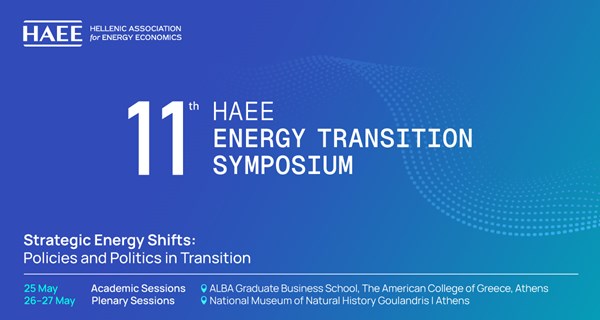
Strategic Energy Shifts: Policies and Politics in Transition 📍 National Museum of Natural History Goulandris, Athens The second day of the 11th HAEE Energy Transition Symposium brought together policymakers, energy executives, academics, and international stakeholders for a high-level dialogue on the future of energy security, regional resilience, and sustainable growth in Southeast Europe. Opening the day's discussions, Minister of Environment & Energy Stavros Papastavrou, Joshua Volz, Special Envoy for Global Energy Integration at the U.S. Department of Energy, and Osama Mobarez, Secretary General of the East Mediterranean Gas Forum (EMGF), explored the growing role of energy security as a pillar of geopolitical stability. Moderated by Prof. Kostas Andriosopoulos, the discussion highlighted the strategic importance of the Vertical Corridor and broader regional cooperation in strengthening Europe's resilience against supply disruptions. Speakers emphasized that diversification can only be achieved through coordinated action among governments, operators, and markets, while regional infrastructure and East Mediterranean gas resources were identified as key elements of Europe's future energy security architecture. In a high-level discussion on market resilience and geopolitical uncertainty, George Alexopoulos, Deputy CEO & Chief Strategy Officer of HELLENiQ ENERGY, and Franck Neel, Executive Board Member of OMV Petrom examined how international oil and gas markets have adapted to ongoing geopolitical disruptions, including instability in the Middle East and pressure on major trade routes. Speakers highlighted the role of LNG availability, diversified supply chains, and Greece’s growing importance as a Mediterranean refining and energy hub. On the third panel of the day, the future role of natural gas in Europe was examined by Maria Rita Galli, CEO of AKTOR LNG, Konstantinos Kotoulas of Cranmore Partners, and Nikos Satras, Head of Natural Gas Business Unit at Motor Oil & Dioriga Gas. Moderated by Christos Papaleonidas, the discussion focused on the balance between energy security, affordability, and sustainability amid growing geopolitical uncertainty. Panelists stressed that natural gas will continue to play a critical role in Europe's energy system for decades, particularly in supporting industrial competitiveness and system flexibility. A recurring message was the need for stable regulatory frameworks and greater investor confidence to unlock private capital and accelerate strategic infrastructure investments. As renewable energy penetration accelerates across Europe, industry leaders and academics explored the urgent need for battery storage and grid modernization to address curtailment challenges and ensure system flexibility. The panel featured Pantelis Capros, Oskaras Alšauskas, Apostolos Panos and Georgios Stamtsis. Speakers stressed that storage integration will become one of the defining priorities of Europe’s clean energy transition. The latest white paper by the HELLENiQ ENERGY Center for Sustainability and Energy @Alba and Center on Global Energy Policy of Columbia University, that examines transformation of Europe's gas market was presented by Anne-Sophie Corbeau, Global Research Scholar at Columbia University's Center on Global Energy Policy, joined Prof. Kostas Andriosopoulos. Corbeau outlined how LNG imports have nearly doubled since 2021 while gas demand has fallen significantly across Europe. The discussion explored multiple risks facing the region, including geopolitical instability, LNG supply disruptions, cybersecurity threats, storage challenges, and increasing dependence on global gas markets. One of the most impactful sessions of the day was “EmpowerMed Women”, moderated by Georgia Giannakidou, with the participation of Alexandra Sdoukou, Enas Shabana and Maria Rita Galli. The discussion focused on leadership opportunities for women in the evolving energy sector, emphasizing the importance of STEM education, mentorship, visibility, and institutional accountability. “Inclusion should not be assumed as an automatic outcome of the energy transition.” Later on, the same day, the challenge of preparing the workforce for a rapidly evolving energy sector was examined by Athanasios Dagoumas, Nikolaos Bakatselos, Panagiotis Papastamatiou, and Angelos Antonakakis, under the moderation of Kostas Axarloglou, Dean of Alba Graduate Business School. Speakers agreed that the sector is undergoing simultaneous transformations driven by digitalization, artificial intelligence, decarbonization, and geopolitical change. While AI is expected to reshape many aspects of energy management, panelists argued that human capital will become even more valuable rather than less. The panel discussion Climate Resilience & Circular Economy: A Unified Strategy For Sustainable Growth, was moderated by Prof. Thanos Bourtsalas of Columbia Climate School, the panel featured Prof. Konstantinos Aravossis, UNESCO Chairholder on Green Innovation and Circular Economy, and George Kremlis, Ambassador of EPLO to Bulgaria and Director of the Circular Economy and Climate Institute. The discussion focused on the growing convergence of climate adaptation policies, circular economy strategies, and water resource management. Free Registration Open | Final Day The 11th HAEE Energy Transition Symposium concludes tomorrow with its 3rd and final day, featuring high-level discussions, strategic insights, and networking opportunities with leading voices from across the global energy sector. 📍 Free Registration Open Admission is free upon registration. 
|